Showing posts with label Arthur Godfrey. Show all posts

Sunday, August 30, 2009

Blogpost #24

Hello, hello, hello! This week's program is an hour-long salute to one of the most infamous names in broadcasting history. Arthur Godfrey was born August 31, 1903, and I'm remembering his birthday with a collection of rare clips from his various TV and radio shows covering the years 1939 to 1981.

Arthur began his radio announcing career in 1930 and became known for his casual, folksy style of broadcasting. Listeners found him extremely charismatic, which helped make him one of the most effective commercial spokesmen of radio's golden age.

President Roosevelt was a big fan of Arthur's, and he regularly tuned in to his early-morning radio on WJSV, Washington, D.C. There's a story that Roosevelt liked him so much that he arranged to have one of his shows recorded on September 21, 1939 for the National Archives. That recording is available online from archive.org. It's also been digitally restored and is available for purchase from radioarchives.org.

Arthur was offered a morning variety show by CBS Radio after he received critical acclaim for his emotional live eyewitness coverage of Roosevelt's funeral procession on April 14, 1945. You can hear it online on the Eyewitness To History site.

At the height of his popularity in the early fifties, Arthur had a daily radio show and several weekly TV shows. Sadly, his public image as a friendly, trustworthy broadcaster took a beating in the newspapers following his controversial on-air farewell to cast member Julius LaRosa on October 19, 1953. YouTube has several clips from Arthur's TV shows, including an episode of Biography that features Julius looking back on the incident decades later.

Arthur appeared as a guest on many TV talk shows in the sixties and seventies, including one memorable appearance with David Frost when he proudly announced that he'd had a vasectomy. He recorded a single called "This Is All I Ask" in 1964 which he performed on many TV programs, including the Jack Paar Program. That performance is available on DVD from Amazon.

Arthur's farewell appearance on TV came on a 1981 PBS special titled "The Fifties: Moments To Remember" when he reminisced about his career, played a 1953 clip of his show, and performed his 1947 hit "The Too Fat Polka" in the Grand Ballroom of New York's Waldorf-Astoria.

Next week's show will mark the seventieth anniversary of the start of World War II. We'll feature a hard-to-find documentary from a 1959 LP in which the late Walter Cronkite dramatically recaps the events in Europe during the thirties that led up to it. Your homework assignment for next week is to listen to the vintage radio news reports from the BBC Archives to determine why Britain's government declared war on Germany even though their country hadn't been attacked yet. Thanks for listening and thanks for reading.

Sunday, August 23, 2009

Blogpost #23

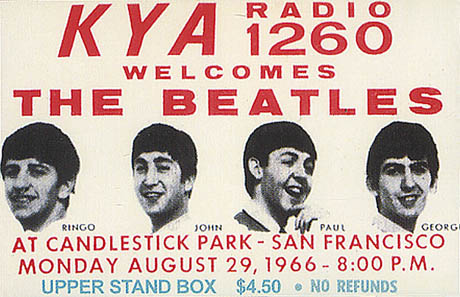
Welcome back, Beatles fans! This week marks the anniversary of their farewell concert at San Francisco's famed Candlestick Park on August 29, 1966. The Beatles' 1969 live rooftop performance (as seen in 'Let It Be) is not generally considered their farewell concert, because it was unannounced and was staged for the cameras. The San Francisco concert came at the end of three weeks of live dates in America, and the Beatles had secretly agreed that it would be their last tour ever.

Candlestick Park was built for baseball teams and not rock bands, so the group was obliged to perform on an elevated stage surrounded by a protective cage and positioned over second base. Shortly before the concert, Paul McCartney asked his press officer Tony Barrow to tape it as a souvenir. He had no time to rent professional recording equipment, so he brought a portable cassette recorder out on the field, pointed his microphone at the speakers and hoped for the best.

The cassette ran for thirty minutes, and was later put up for auction in London. The historic tape was digitally remastered and released by Bulldog Records on LP and CD in 1988 without permission from the Beatles. Bulldog was an Italian label founded in 1987 to exploit a loophole in international copyright law; apparently the Beatles' studio recordings were protected, but not their live concerts.

According to Eric Lefcowitz's 1987 book "Tomorrow Never Knows: The Beatles' Last Concert", the Beatles emerged from the dugout at 9:27 pm, with Paul documenting the event with his camera as he approached the stage. Before the first number started, Ringo accidentally swiveled his mike stand around in the wrong direction, making his drums inaudible for most of the concert. The guitars sounded hollow and distant because they were only being picked up through the vocal mikes.

Paul introduced "If I Needed Someone" as being "recorded by the blah-blah". He was actually referring to the 1966 single version by the Hollies, but Paul muffled their name on purpose because George hated what they did to his song. John introduced "Day Tripper" as "the one about the naughty lady", but couldn't remember when he recorded it. During the mournful "Baby's In Black", the crowd unexpectedly started cheering wildly. Their reaction was completely unconnected to the song; they were just applauding a group of five teenage boys that almost reached the stage before being ejected by security.

George jokingly introduced "I Feel Fine" as a 1959 song, calling it "very old indeed". Paul was very uncomfortable with the windy conditions in Candlestick Park, loudly complaining "It's a bit chilly!" Ringo made a quick adjustment to his microphone stand after realizing he was about to start singing into the wrong end, prompting a sarcastic remark from Paul: "Talented!" Another group of gate-crashers were captured by police as they attempted to rush the stage, and Paul impatiently waited for the crowds to quiet down before starting "Paperback Writer".

Paul introduced the eleventh and final song by wearily asking the crowds to "join in and clap... sing... talk?", to which John added "Dance?" The Beatles chose "Long Tall Sally" as their farewell concert performance after eight years and 1400 shows. Sadly, the song lasted longer than the cassette did. Only the first forty seconds were saved on tape. At 10 pm, the group left the stage, climbed into an armored van, and headed for the airport. On the flight home, George breathed a sigh of relief and announced that he was no longer a Beatle.

After their touring days were over, the group devoted their time to crafting an LP that would recreate the experience of a live concert, which became 1967's critically acclaimed "Sgt. Pepper". The album's success encouraged the Beatles to continue experimenting with new sounds in the recording studio, despite some complaints that they were producing music that was too complex for their teenage followers.

By 1969, the group had abandoned their progressive approach to music for their "Get Back" single, which was designed to recapture the energy and spontaneity of their early hit records. This regressive approach to recording was suggested by Paul, who had claimed to be strongly opposed to the idea back in 1966. "We're never going to do that," he told British radio deejay Ken Douglas during the American tour. "If we ever have to do that - if anyone suddenly says 'You're going too way out, you've got to get back to then' - well, we'll give up, you know?" This ironic and revealing quote comes from a rare LP released in 1966 by the Ring Around The Pops Foundation to raise funds for the blind. It was titled "Beatle Views", and I've never seen a copy anywhere. Edited highlights were released on a 1984 LP from Silhouette Records titled "The British Are Coming", which included a 3-D cover and a pair of cardboard eyeglasses.

The Candlestick Park tape is available on You Tube in four parts, starting with this one. I invite you to tune in to A Time To Remember next Sunday morning for my birthday tribute to the late Arthur Godfrey. He was once regarded as the most popular and powerful announcer in broadcasting. I'll present a live radio interview with Chicago radio personality Ed Schwartz from 1976, plus a live performance with Jose Melis on the Jack Paar Program from 1964. Thanks for listening and thanks for reading.