Showing posts with label Beatles. Show all posts

Sunday, November 22, 2009

Blogpost #32

Welcome back, Beatle people! November 24 marks the birthday of Pete Best, born 1941 and still remembered as the unlucky soul who was "drummed out" of the Beatles just before the start of Beatlemania. This week's show features my biography of Pete, including the true reason he was dismissed from the group.

Pete made his American TV debut on March 30, 1964 as a mystery guest on the game show "I've Got A Secret" with Garry Moore as host. A clip from that show is on YouTube.

In March 1982, Pete gave an in-depth interview about his life to Los Angeles FM deejay Jim Ladd, who released an edited version on an LP titled "Like Dreamers Do" that also featured ten tracks from the Beatles' Decca studio sessions. It's currently available on eBay from a collector who wants $120 for a sealed copy. If you're only interested in the interview, it's available on video for only ten bucks from Robert York at eskimo.com.

If you're interested in Pete's life story, he's written three autobiographies, including a 1985 book that completely ignores Neil Aspinall's relationship with Pete's mom. Next week we'll feature highlights from the Million Dollar Quartet sessions from 1956 that inspired the stage musical. Thanks for listening!

Sunday, August 23, 2009

Blogpost #23

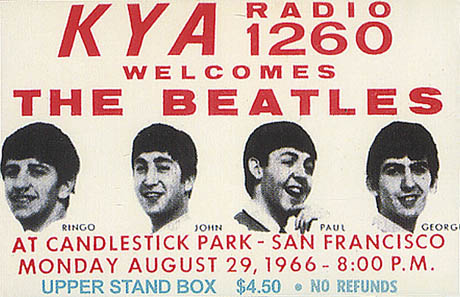
Welcome back, Beatles fans! This week marks the anniversary of their farewell concert at San Francisco's famed Candlestick Park on August 29, 1966. The Beatles' 1969 live rooftop performance (as seen in 'Let It Be) is not generally considered their farewell concert, because it was unannounced and was staged for the cameras. The San Francisco concert came at the end of three weeks of live dates in America, and the Beatles had secretly agreed that it would be their last tour ever.

Candlestick Park was built for baseball teams and not rock bands, so the group was obliged to perform on an elevated stage surrounded by a protective cage and positioned over second base. Shortly before the concert, Paul McCartney asked his press officer Tony Barrow to tape it as a souvenir. He had no time to rent professional recording equipment, so he brought a portable cassette recorder out on the field, pointed his microphone at the speakers and hoped for the best.

The cassette ran for thirty minutes, and was later put up for auction in London. The historic tape was digitally remastered and released by Bulldog Records on LP and CD in 1988 without permission from the Beatles. Bulldog was an Italian label founded in 1987 to exploit a loophole in international copyright law; apparently the Beatles' studio recordings were protected, but not their live concerts.

According to Eric Lefcowitz's 1987 book "Tomorrow Never Knows: The Beatles' Last Concert", the Beatles emerged from the dugout at 9:27 pm, with Paul documenting the event with his camera as he approached the stage. Before the first number started, Ringo accidentally swiveled his mike stand around in the wrong direction, making his drums inaudible for most of the concert. The guitars sounded hollow and distant because they were only being picked up through the vocal mikes.

Paul introduced "If I Needed Someone" as being "recorded by the blah-blah". He was actually referring to the 1966 single version by the Hollies, but Paul muffled their name on purpose because George hated what they did to his song. John introduced "Day Tripper" as "the one about the naughty lady", but couldn't remember when he recorded it. During the mournful "Baby's In Black", the crowd unexpectedly started cheering wildly. Their reaction was completely unconnected to the song; they were just applauding a group of five teenage boys that almost reached the stage before being ejected by security.

George jokingly introduced "I Feel Fine" as a 1959 song, calling it "very old indeed". Paul was very uncomfortable with the windy conditions in Candlestick Park, loudly complaining "It's a bit chilly!" Ringo made a quick adjustment to his microphone stand after realizing he was about to start singing into the wrong end, prompting a sarcastic remark from Paul: "Talented!" Another group of gate-crashers were captured by police as they attempted to rush the stage, and Paul impatiently waited for the crowds to quiet down before starting "Paperback Writer".

Paul introduced the eleventh and final song by wearily asking the crowds to "join in and clap... sing... talk?", to which John added "Dance?" The Beatles chose "Long Tall Sally" as their farewell concert performance after eight years and 1400 shows. Sadly, the song lasted longer than the cassette did. Only the first forty seconds were saved on tape. At 10 pm, the group left the stage, climbed into an armored van, and headed for the airport. On the flight home, George breathed a sigh of relief and announced that he was no longer a Beatle.

After their touring days were over, the group devoted their time to crafting an LP that would recreate the experience of a live concert, which became 1967's critically acclaimed "Sgt. Pepper". The album's success encouraged the Beatles to continue experimenting with new sounds in the recording studio, despite some complaints that they were producing music that was too complex for their teenage followers.

By 1969, the group had abandoned their progressive approach to music for their "Get Back" single, which was designed to recapture the energy and spontaneity of their early hit records. This regressive approach to recording was suggested by Paul, who had claimed to be strongly opposed to the idea back in 1966. "We're never going to do that," he told British radio deejay Ken Douglas during the American tour. "If we ever have to do that - if anyone suddenly says 'You're going too way out, you've got to get back to then' - well, we'll give up, you know?" This ironic and revealing quote comes from a rare LP released in 1966 by the Ring Around The Pops Foundation to raise funds for the blind. It was titled "Beatle Views", and I've never seen a copy anywhere. Edited highlights were released on a 1984 LP from Silhouette Records titled "The British Are Coming", which included a 3-D cover and a pair of cardboard eyeglasses.

The Candlestick Park tape is available on You Tube in four parts, starting with this one. I invite you to tune in to A Time To Remember next Sunday morning for my birthday tribute to the late Arthur Godfrey. He was once regarded as the most popular and powerful announcer in broadcasting. I'll present a live radio interview with Chicago radio personality Ed Schwartz from 1976, plus a live performance with Jose Melis on the Jack Paar Program from 1964. Thanks for listening and thanks for reading.

Sunday, August 16, 2009

Blogpost #22

Greetings, Elvis fans! This week's show is a memorial tribute to Elvis Presley, who died exactly 32 years ago today on August 16, 1977. We're paying our respects to him with a collection of rare early recordings, including the legendary demo disc he made as a present for his mother in the Summer of 1953, around the time this yearbook photo was taken.

What was Elvis like back in those days? According to information he supplied for his high school yearbook and his driver's license, he had brown hair, blue eyes, weighed 153 lbs, stood 5' 11", and lived at 185 Winchester in Memphis, Tennessee. He had just graduated from Hume High School with majors in Shop, History and English.

He was inspired by an article by Clark Porteous published in the Memphis Press-Scimitar on July 15, 1953 about a recording studio called the Memphis Recording Service run by Sam Phillips, whose motto was "We Record Anything - Anywhere - Anytime". The following Saturday, the eighteen-year old Presley came by with his guitar and cut an acetate disc of two slow ballads from the 1940's: "My Happiness" and "That's When Your Heartaches Begin". Elvis later revealed during the "Million Dollar Quartet" session of December 4, 1956 that he'd lost his only copy of the record. It later turned up in the collection of Ed Leek, a retired airline pilot and former classmate of Elvis who had kept it hidden away for thirty-five years. Both sides of the disc can be found on RCA's "Sunrise" 2-disc collection, available from Amazon.

When Elvis died, it seemed as if everyone of his fans needed to get their hands on some kind of souvenir connected to him. A reporter named Roy Blount, Jr. flew to Memphis and arrived at Graceland within hours of his death. He saw a rolled-up copy of the Memphis Press-Scimitar lying on the ground with a rubber band around it, and the gatekeeper told him it was Elvis' last newspaper. In his book "What Men Don't Tell Women", Roy revealed that he took it as a souvenir, and what Elvis fan wouldn't have done the same thing?

My mom was a diehard Elvis fan as well, and in the week after his death she devoted all of her free time to saving every possible Elvis-related TV and radio program on tape. I found a memorable clip from Eddie Schwartz' all-night radio show in which he announces that Elvis "died of natural causes", which was later proven to be untrue. He had actually died of heart failure caused by an overdose of prescription drugs from a doctor who just couldn't say no. There was a real lesson to be learned from his death, and it was a shame that Michael Jackson never learned it.

Shortly after Elvis' death, his former guitar player Scotty Moore gave an interview to a reporter in which he revealed how they made their first record together in 1954 within days of their first meeting. That interview was quickly issued on record to cash in on the demand for fresh Elvis material. This ghoulish piece of exploitation is now ironically a collector's item, but I included a lengthy clip from the album anyway because it's a genuine eyewitness account of history.

From 1954 to 1956, Elvis appeared practically every week on the Louisiana Hayride radio show over KWKH, Shreveport. He plugged his records and his personal appearances, and he got paid thirty dollars a week for the first year. Only a handful of his live broadcasts were saved, and some of them can be found on "The Elvis Broadcasts On Air", a well-packaged CD collection on Stardust. Sound quality varies from excellent to unlistenable, but it's still available from Amazon.

Comedian and talk show host Steve Allen earned the wrath of Elvis fans when he booked him on his prime-time variety show on July 1, 1956 to sing "Hound Dog" in white tie and tails to an actual Bassett hound, who ignored him for the entire song. It was a humiliating experience for Elvis, who never appeared with Steve again. In 1996, Varese Sarabande issued a CD compilation of clips from his various TV shows, and one of them was a comedy sketch featuring Elvis with Andy Griffith and Imogene Coca as stars of a Western-style TV show. I included it for its rarity, not for its comedy. Apparently the CD is pretty rare as well, judging by the price of a used copy on Amazon.

The phrase "Elvis Has Left The Building" is now part of American pop culture, but someone had to be the first one to say it. According to my research, it was first spoken by KWKH announcer Frank Page at the close of a live radio broadcast on December 15, 1956, and I couldn't think of a more perfect way to close my memorial tribute. The only thing I haven't mentioned from the program is an instrumental song from 1937 that I used as background music. It's called "Smoke Rings" and it's by Glen Gray and the Casa Loma Orchestra.

Next week's show will be another tribute to a great rock act. I'll be looking back at the Beatles' farewell stage performance in San Francisco on August 29, 1966. I'll be playing the tape of that concert in its entirety. Thanks for listening.

Sunday, June 21, 2009

Blogpost #14

Welcome Back, Beatle fans! I hope you enjoyed last week's full-length interview with Paul McCartney. This week's show celebrates the anniversary of the Beatles' first professional recording session. It happened nearly half a century ago, if you can believe that. The session actually resulted in a hit single in Germany, and it started a chain of events that changed the world in a million ways.

It all started in Hamburg, Germany in June 1961 at a nightclub called The Top Ten. One of their star attractions was a 20-year old rock singer named Tony Sheridan, who often performed live with the Beatles. He was signed to a contract with Polydor Records and the Beatles were hired as his backing group, and they received a one-time payment with no royalties.

Their first session was scheduled for a Thursday night, June 22, 1961, but it stretched into the following Friday morning. Tony and the boys only had time to tape five numbers, so they had to return the following Saturday morning to tape two more. In addition to these seven songs, there was an eighth number taped nearly a year later during their return to Hamburg. Tony Sheridan was not available, so he added his vocal at a later session. Reports of a ninth track (allegedly the Beatles performing "Swanee River" with added piano and sax) have been greatly exaggerated.

The first release from the Beatles/Sheridan sessions was "My Bonnie", an uptempo version of the old folk lullaby "My Bonnie Lies Over The Ocean". It came out on a German single in late 1961 with a slow introduction sung by Sheridan in German. It was backed with "The Saints", based on "When The Saints Go Marching In". The group was credited as Tony Sheridan and The Beat Brothers on the single, which sold about 20,000 copies and peaked at 32 on the Deutsche Hit Parade in January 1962. That same month, Polydor reissued the single in Great Britain with a slow introduction in English instead of German. This version was credited to Tony Sheridan and The Beatles. In June 1962, both songs were released on a German LP titled "My Bonnie" with the Beatles being credited on the back cover.

Since the initial release of these tracks in 1961, Polydor has reissued them in every country in every imaginable audio format: singles, EPs, LPs, 8-Tracks, cassettes, and CDs. There's even a documentary on DVD featuring new interviews with Tony Sheridan, and it's available from Amazon.com.

Next week's show will be a birthday tribute to Mel Brooks. You'll hear rare TV appearances with Carl Reiner, Andy Williams, Ed Sullivan and Dick Cavett.